
Checklist: Comparing fitness equipment supplier samples
Fitness equipment samples are useful when each unit is identified, tested against the same requirements, and evaluated with objective evidence and documented preferences. A checklist keeps configuration and safety gaps visible before award.
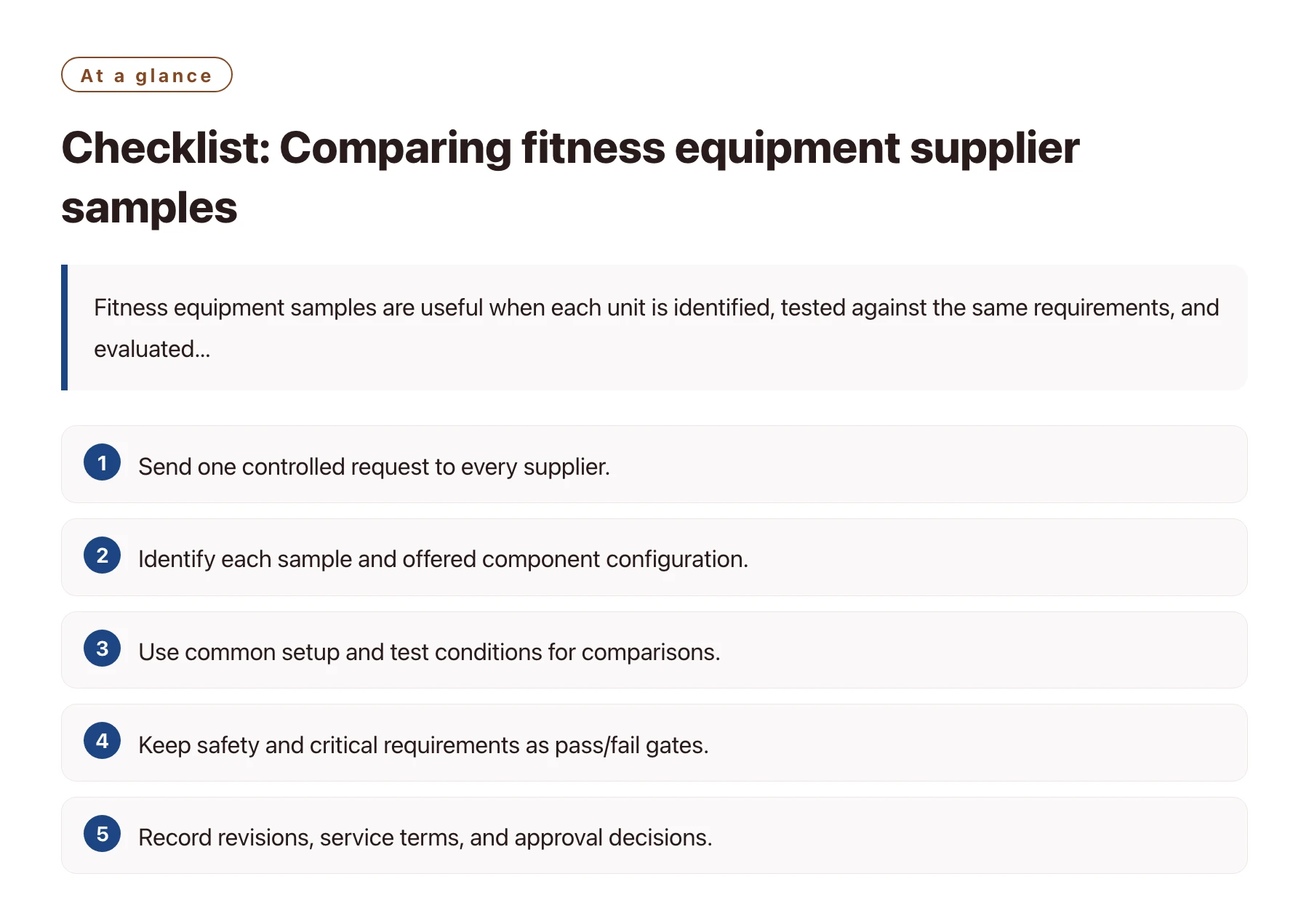
Key takeawaysSend one controlled request to every supplier. · Identify each sample and offered component configuration. · Use common setup and test conditions for comparisons. · Keep safety and critical requirements as pass/fail gates. · Record revisions, service terms, and approval decisions.
A sample review is one step in supplier selection. It should connect the tested unit to the quotation, production version, evidence, and service plan.
1. Select samples from a controlled request
Before suppliers send samples, issue one specification revision describing intended use, user setting, model category, dimensions, load assumptions, controls, finish, accessories, packaging, and destination. Identify which values are mandatory and which may be proposed. A sample sent against an informal request can look suitable while missing a critical option or market-specific feature.
State sample quantity, courier terms, labeling, sample cost, expected ship date, and contact for clarifications. Ask each supplier to identify whether the unit is catalogue stock, a prototype, or production-intent. Record who paid and whether the sample is representative of the quoted manufacturing route.
2. Identify each unit and configuration
Label every sample with supplier, factory, model, revision, serial or lot if available, date received, and included components. Record motor, console, resistance type, sensor, software, upholstery, frame, guards, and accessory configuration where relevant. Similar-looking units may differ in controls, load capability, or service parts.
Photograph identifying marks and unpacking condition before evaluation. Check that the sample matches the quotation and product data sheet. If a component is missing or substituted, document the gap and ask for a corrected sample or written technical explanation before scoring.
3. Use a common comparison environment
Prepare a consistent evaluation area with comparable floor surface, power supply, lighting, control settings, and available space. Confirm that equipment is assembled by the same method or by trained personnel. Note any differences in setup that could affect movement, noise, dimensions, or user experience.
Use a test sheet with requirement, method, expected result, observation, evidence, and reviewer. For subjective attributes such as smoothness or perceived noise, state the observer and conditions and treat the result as a comparative observation rather than a laboratory measurement.
4. Compare fit, adjustment, and basic function
Check footprint, height, clearance, access, setup, adjustment range, stability, controls, emergency stop where applicable, moving parts, and ease of cleaning. Use the intended user profile and installation space. Record whether users can enter, exit, adjust, and operate the sample as the project expects.
For a functional test, define warm-up, duration, settings, load or user input, and pass limits. Capture errors, interruptions, abnormal sounds, or inconsistent controls. Do not extend the test beyond safe operating instructions or ask a supplier to bypass a safeguard for comparison.
5. Review safety and test evidence
ISO 20957-1:2024 specifies general safety requirements and test methods for indoor stationary training equipment; other parts may add product-specific requirements. Have a qualified compliance owner determine what applies to each model, user setting, and destination. A sample review does not establish full regulatory conformity. [1]
Request model-specific reports and declarations that identify exact configuration, date, test method, laboratory, and any limitations. If suppliers provide evidence for a different revision, ask for a documented assessment or additional testing. Keep safety evidence as a required gate instead of treating it as one subjective score.
6. Compare build quality and serviceability
Inspect frame joins, welds, fasteners, finishes, moving parts, cables, guards, upholstery, seams, and replaceable wear items. Use the same viewing and measurement conditions. Note visible differences and link them to expected maintenance, durability, or repair access rather than relying on a general impression of “premium” construction.
Ask each supplier for part lists, part numbers, availability, warranty coverage, claim process, response time, and replacement delivery route. Identify items requiring tools or specialist service. A polished sample may still be costly to support if key components are proprietary or difficult to obtain.
7. Evaluate packaging and delivery presentation
Record carton dimensions, protection, assembly requirements, accessory organization, manuals, labels, and damage on arrival. Confirm what is sample-only packaging and what will be used for production. Ask for the final packing plan where equipment is heavy, fragile, or shipped with loose accessories.
Check whether cartons identify model, revision, language, and destination. Compare the supplier’s shipment assumptions, lead time, booking method, and receiving needs. A sample that arrives intact does not prove the production pack will provide the same protection; request packing evidence or a trial where appropriate.
8. Score evidence separately from preference
Use mandatory pass/fail gates for identity, required functions, safety documents, critical fit, and destination requirements. Then score secondary factors such as appearance, ease of assembly, user interface, serviceability, and price. Agree weights before reviewing supplier names to reduce hindsight bias.
Keep objective measures, document claims, and evaluator preference in separate columns. Record missing evidence and assumptions rather than assigning an arbitrary middle score. If a supplier offers an upgrade, list its price and effect separately so optional features do not distort the baseline comparison.
9. Record feedback and correction rounds
Send suppliers structured comments tied to requirement IDs, with photos or measurements where relevant. Identify what is a correction, a clarification, or a buyer preference. Define the response deadline and whether the revised sample must be retested. Retain the original sample results for traceability.
When a revision arrives, compare its identity and component list with the first unit. Verify changed features and recheck any dependent requirements. Record approval status and open actions. A changed sample should not automatically replace the earlier baseline without review by the relevant technical owner.
10. Make a documented selection decision
Summarize scores, required evidence, deviations, cost, service terms, lead time, and remaining risks. Name the buyer roles that approve design, technical compliance, commercial terms, sample status, and production release. Keep conditional approval tied to specific evidence and a due date before order or shipment.
Buyers sourcing Chinese manufacturers of gym equipment can use a shared checklist to compare supplier samples on one baseline. Confirm the selected production configuration, test evidence, warranty, and packing plan in the final order documents.
Sources
Frequently asked questions
What should be on a fitness equipment sample checklist?
Include identity, configuration, fit, function, safety documents, serviceability, packaging, test conditions, evidence, and open actions.
Can a sample test prove a machine’s useful life?
Not by itself. Long-term durability claims need an agreed method, sample, conditions, acceptance limits, and appropriate evidence.
Should suppliers be scored before safety evidence is reviewed?
Safety and other mandatory requirements should be pass/fail gates before weighted preference scoring.
How do I compare revised supplier samples?
Record the new model and component revision, retest changed and dependent criteria, and keep previous results linked to the change.