
How ODM Fragrance Development Runs, Step by Step
An ODM project is not a shorter version of an OEM project; it is a different sequence. The manufacturer starts from an existing accord or a developed base and adapts it to a brief, which moves most of the technical work to the front and most of the commercial decisions to the middle. On a large programme the whole thing usually runs in eight stages, and each stage ends in a decision the brand has to make rather than a document it merely receives. Knowing where those gates are is what keeps a project from drifting for a month without anyone noticing.
Key takeaways
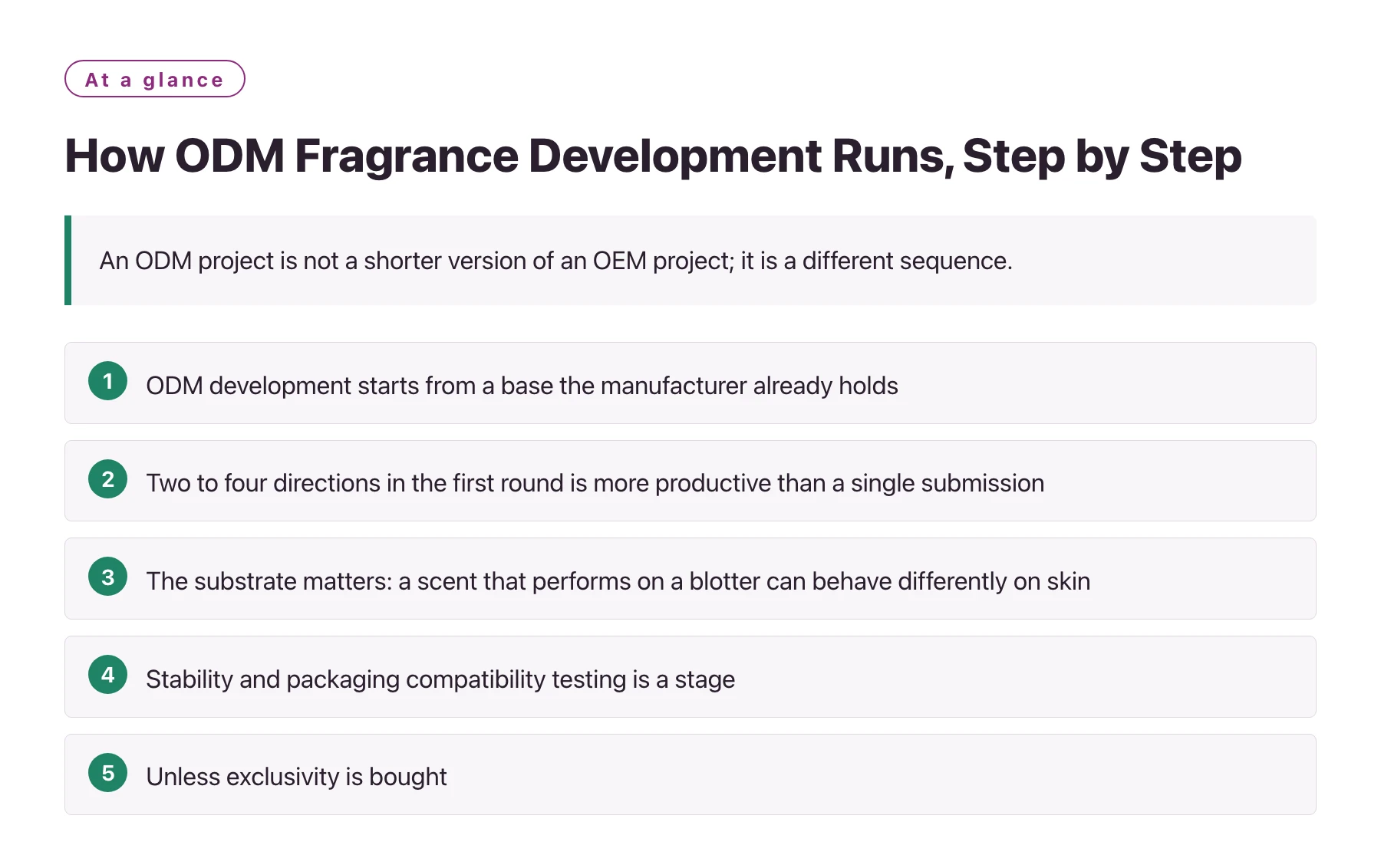
- ODM development starts from a base the manufacturer already holds, so the brief has to define positioning, cost ceiling and target markets before any smelling begins.
- Two to four directions in the first round is more productive than a single submission, because smelling is comparative and abstract descriptions are not.
- The substrate matters: a scent that performs on a blotter can behave differently on skin, in candle wax, or in a body lotion base.
- Stability and packaging compatibility testing is a stage, not a formality, and it is the most common cause of a delayed launch.
- Unless exclusivity is bought, an ODM base can be offered to other clients, which is a commercial term to settle before the first bulk order.
Brands new to fragrance often expect a linear process: brief, sample, approve, produce. In practice the work moves in gates, and the value of the sequence is that each gate produces a decision rather than another round of opinions.
The stages below are written from the product development side of the table. They apply whether you are running a fine fragrance, a home fragrance or a scented body product, although the testing emphasis shifts with the application.
Timings are deliberately not given, because they depend on how settled the brief is, how fast the brand responds, and how much reformulation the direction needs.
Stages 1 and 2: the brief and the feasibility screen
The brief is the only thing the whole project is measured against, so it deserves more effort than it usually gets. A useful ODM brief is written, short, and specific about the things that cannot be changed later.
Feasibility comes next, and it is where an experienced partner earns its fee. A direction that looks straightforward on paper can run into a restricted material limit, a cost ceiling that the requested materials cannot meet, or a stability issue in the intended packaging.
What a usable ODM brief contains
Category and application, target consumer and market, price ceiling per unit, desired olfactive direction with two or three reference products, and the performance expectation, meaning whether the scent needs to project or stay close. Add the fill size and the packaging route, because both constrain which materials are viable.
The regulatory screen before the creative work
Fragrance materials are governed by the IFRA Standards, which set limits by product category and are revised periodically, so a direction has to be screened against the current version before it is developed rather than after it is loved [1]. Doing this early saves the specific disappointment of a perfect scent that cannot be sold in the intended application.
Stages 3 to 5: directions, selection and refinement
- First submissionTwo to four directions against the brief, each with a note on how it differs, submitted on blotters and in the intended application.
- Comparative evaluationThe brand smells the set side by side, ranks them, and states what to change rather than what to keep.
- Modification roundsOne direction is taken forward and adjusted in defined steps, with each round documented as a numbered version.
- Application testingThe candidate is tested on the real substrate: skin, wax, alcohol base, lotion or detergent, at the dosage the product will use.
- Dosage and cost reviewDosage is optimised against both performance and the cost ceiling, which is where an ODM project most often finds money.
- Stability and compatibilityAccelerated ageing, colour and odour checks in the actual packaging, and interaction with the bottle, pump or cap materials.
- Selection lockedOne reference formula version is chosen and frozen, with a retained sample held by both parties.
Stage 6: documentation and safety
Once the formula is frozen, the paperwork starts. This is the stage where an ODM project either becomes straightforward or reveals that a material choice was made on the wrong assumption six weeks earlier.
Two documents do most of the work: the fragrance conformity statement against the current IFRA Standards, and the safety documentation that feeds the finished product assessment in the destination market. The second is a finished-product obligation, not a fragrance one, and it is worth being clear about who produces which part.
Analytical work such as stability, compatibility and any specific testing is carried out by laboratories working to defined methods, and the reports are what an importer will ask for later [2]. Building that file as the project runs is far cheaper than reconstructing it before a shipment.
Who owns what on paper
The fragrance house typically provides the composition, the allergen declaration and the conformity statement. The brand, or its responsible person in the market, holds the finished product file. Confusing those two roles is a common cause of a late scramble before a first shipment.
Stages 7 and 8: scale-up and bulk release
Scale-up is where a formula that behaved beautifully in a beaker meets a production vessel. Dosage is confirmed, mixing and order of addition are fixed, and the pilot batch is compared against the frozen reference. Small differences at this stage are normal; the test is whether they are inside the agreed tolerance or outside it.
Bulk production then follows the frozen process, with in-process checks and a retained sample. The reference from stage 5 is the standard, which is why it must be sealed, dated and versioned rather than kept in a drawer as a general reminder of what the scent was supposed to be.
For a brand buying an ODM service, the practical way to keep all of this coherent is to treat the development sequence and the factory as one project, with the manufacturer owning the handover points. That is the case a bespoke fragrance development and production scope is meant to cover, and it is why buyers shortlist an ODM perfume manufacturer on process rather than on the first sample alone.
It also explains why the same brief can produce very different development experiences. A partner built around one-stop scent development will have a defined gate at each stage, so the brand always knows which decision is outstanding. A partner without that structure tends to send samples and wait.
Sources
- IFRA: Safe Use and Fragrance Science —— IFRA's explanation of how fragrance materials are scientifically assessed for safe use and how those conclusions are applied by the industry.
- SGS: Cosmetics, Personal Care & Household Testing —— Testing, inspection and certification services for cosmetics and personal care, including microbiological, stability and safety testing aligned with cosmetics GMP.
Frequently asked questions
How is ODM different from private label?
Private label usually means the brand takes a finished, existing product and applies its own name and packaging. ODM is broader: the manufacturer develops or adapts a scent to the brand's brief, which may then be produced exclusively or shared depending on the agreement.
Is an ODM formula exclusive to my brand?
Not by default. Unless exclusivity is negotiated and paid for, a manufacturer may offer a similar base to other clients. If exclusivity matters to your positioning, settle it in writing before the first bulk order rather than after the product is on shelf.
How many modification rounds should I expect?
Typically two to four, depending on how specific the brief is. Rounds become cheaper and faster when feedback describes a direction, such as less sweetness or more dry wood, instead of simply saying it is not right.
Why does a scent smell different in the finished product than on a blotter?
Because the substrate changes how materials evaporate and how they interact. Testing in the intended application, at the intended dosage, is the only way to judge performance; the blotter is a development tool, not a verdict.
What can delay an ODM project most often?
A brief that keeps changing, slow feedback between rounds, and stability or compatibility problems discovered late because the packaging was not fixed early. Locking the packaging route before the final round prevents most of the last one.