
Prebuilt Cabinets: The Spec Sheet Checklist
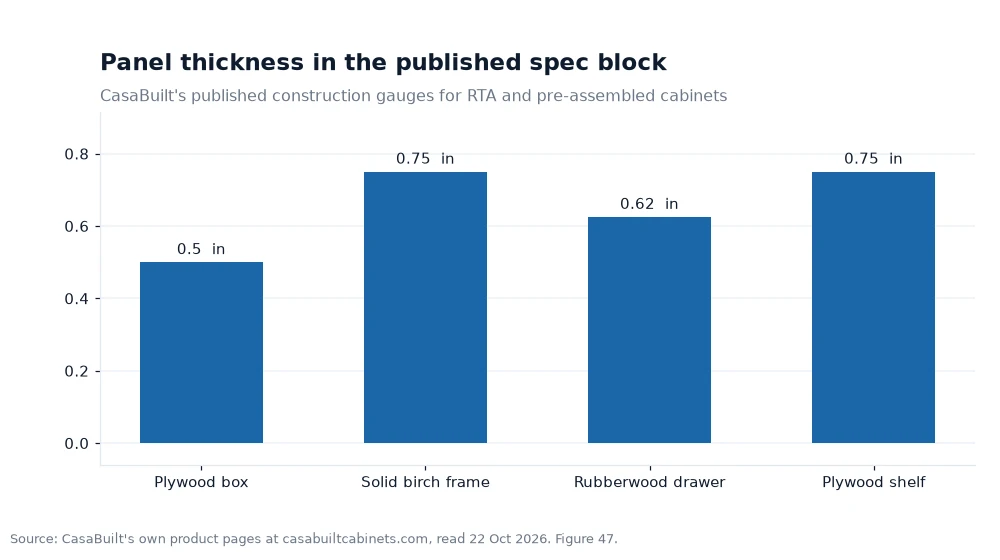
A cabinet quote tells you the price and the door style. It rarely tells you the four panel thicknesses that decide how the box behaves after five years. CasaBuilt publishes those gauges: a 1/2 in plywood box, a 3/4 in solid birch face frame, a 5/8 in rubberwood drawer and a 3/4 in plywood shelf. Copy them onto any quote before comparing totals.
Key takeaways
- The published box is 1/2 in birch plywood with a natural birch interior and color-matched exterior sides.
- The face frame is 3/4 in by 1-1/2 in solid birch; shelves are 3/4 in adjustable plywood.
- Drawers are 5/8 in rubberwood with dovetail joinery on soft-close, full-extension undermount glides.
- The finish is seven layers of paint with a UV protective finish, backed by a one-year defect warranty.
A checklist is the only showroom you need
A showroom sells a kitchen by letting a buyer open a door and feel the glide. That test is useful and easy to stage, because a display cabinet is adjusted weekly and never sees a tenant or a sack of flour. The specification sheet is harder to stage, and it is the part that survives the first year.
The checklist below is not a ranking. It is a set of fields that should appear in writing on every quote, with a number or a named material beside each one. A seller who cannot fill in a field has told you something useful, and one who fills in all ten has given you a document you can compare against another document.
Take the list to the quote stage rather than the inspiration stage. Door style is a taste decision and can be made last. Panel thickness, drawer joinery, hinge adjustment and finish coats are cost decisions disguised as details, and they are settled before the order is placed or not at all.
Ten fields to copy onto the quote
Every value in the third column is published by CasaBuilt for its RTA and pre-assembled lines. The fourth column is what to write beside it when another seller quotes the same job.
| Field | What it decides | Published value | What to ask another seller |
|---|---|---|---|
| Box panel | Rigidity and screw holding | 1/2 in birch plywood | Panel material and thickness |
| Box interior | Wipe-down and moisture tolerance | Natural birch, exterior color-matched | Interior finish and edge banding |
| Face frame | Opening stiffness and door alignment | 3/4 in x 1-1/2 in solid birch | Frame material and width |
| Door | Weight, profile and repaintability | Rubberwood frame, MDF panel, full overlay | Frame species and panel material |
| Hinge | Door sag and adjustment range | Soft-close concealed, 6-way adjustable | Adjustment axes and closing action |
| Drawer glide | Travel and load feel | Soft-close undermount, full extension | Extension length and closing action |
| Drawer box | Joint strength and interior volume | 5/8 in rubberwood, dovetail | Side thickness and joint type |
| Shelf | Sag across the cabinet width | 3/4 in plywood, adjustable | Thickness and adjustment |
| Finish | Color hold and cleanability | 7 layers of paint, UV protective finish | Coats and topcoat type |
| Warranty | Who pays when a part fails | 1 year, manufacturing defects | Term, coverage and remedy |
Two rows are usually missing from a verbal quote: the box interior and the shelf. Both are invisible after installation, and both affect how a cabinet feels when a plate is dragged out at eye level.
The warranty row is the one most often overstated in conversation. CasaBuilt publishes one year covering manufacturing defects in materials and workmanship under normal residential use, with a replacement part or an appropriate solution. That is a clear promise and a narrow one. A quote that implies more should be asked to put the extra coverage in writing, with a term and a remedy.
Reading the four thicknesses
Four gauges sit in the published spec block: 0.75 in for the face frame and the shelf, 0.625 in for the drawer sides, and 0.5 in for the box panel. The numbers are not arbitrary. They are the common fractional steps in US cabinet construction, and each one carries a different job.
The box panel is the thinnest at 1/2 in because it is braced by the face frame and the back. The face frame is 3/4 in because it is the member the doors hang from, and it is 1-1/2 in wide to give the hinge screws something to bite into. The shelf is 3/4 in because it spans the full cabinet width unsupported. The drawer box is 5/8 in because it is a moving part that has to stay light.
Compare the same field across quotes, not the total. A cabinet with a 3/4 in box and a 1/2 in drawer is not better than one with a 1/2 in box and a 5/8 in drawer; they are built for different jobs. Four numbers side by side are more readable than a paragraph of marketing copy.
Thickness has a cost. A thicker panel uses more material and more shipping weight, and the published prebuilt cabinets keep the box at 1/2 in while spending the extra material on the frame, the shelf and the drawer. That is a design choice a buyer can judge, but only if the numbers are on the page.
Hardware and finish: the fields buyers skip
Hardware is where a cheap cabinet announces itself first. CasaBuilt publishes soft-close concealed hinges with six-way adjustment, which means the door can be moved in and out, up and down, and left and right after installation. Six axes matter in an old kitchen, because no wall is plumb and no cabinet run is perfectly straight.
The glides are soft-close undermount with full extension, so the drawer pulls all the way out and the contents at the back are reachable. Undermount means the glide sits under the drawer box rather than on its side, which keeps the interior width usable. Full extension is the part buyers forget to check, and it is the difference between a 24 in drawer that opens 18 in and one that opens all the way.
The finish is listed as seven layers of paint with a UV protective finish. Coats are labor, and the UV layer is what keeps a painted door from drifting in a sunlit kitchen. A seller who quotes three coats is not automatically worse, but the buyer should know the count before comparing price.
What arrives in the carton is the last field. Flat-packed orders include hardware and printed steps, with assembly videos and support available. Orders that arrive joined skip the assembly but not the inspection. Check the packaging guide before signing for a delivery, and open the cartons while the freight bill is still unsigned.
Worked example
Read the chart from the thickest bars down: the face frame and the shelf are both 0.75 in, the drawer box is 0.625 in and the plywood box is 0.5 in. Put each stressed part against the panel it is fixed to. The frame is 0.75 divided by 0.5, or 1.5 times the box thickness, and the shelf matches it. The drawer is 0.625 divided by 0.5, or 1.25 times.
The drawer sits between them. It is 0.625 minus 0.5, or 0.125 in thicker than the box, which is 25% because 0.125 divided by 0.5 is 0.25. Against the 0.75 in shelf it is 0.75 minus 0.625, or 0.125 in thinner, which is 16.7% of the shelf because 0.125 divided by 0.75 is 0.167.
The fractions explain the steps: 0.5 in is 4/8, 0.625 in is 5/8 and 0.75 in is 6/8, so each gauge is one eighth of an inch apart, or 3.175 mm because 0.125 times 25.4 is 3.175. In millimeters the same values are 12.7 mm, 15.875 mm and 19.05 mm, each multiplied by 25.4 from the inch figure. A quote that lists 16 mm board is therefore close to the 5/8 in drawer, and a quote that lists 18 mm board is between the drawer and the shelf.
Frequently asked questions
Is a 1/2 in cabinet box strong enough?
In this construction the 1/2 in birch plywood box is braced by a 3/4 in by 1-1/2 in solid birch face frame, which is where the doors and hinges attach. The number to compare is the box material and the frame together, not the box thickness on its own.
Are the drawers dovetailed?
Yes. The drawer box is published as 5/8 in rubberwood, joined with dovetails rather than fastened with staples, on soft-close undermount glides with full extension. Interlocking sides and front spread the load through the joint, which is why dovetails show up on cabinets built for heavy use.
What does the warranty actually cover?
One year covering manufacturing defects in materials and workmanship under normal residential use, with a replacement part or an appropriate solution provided. It does not cover installation damage or wear from misuse. Ask any seller for the term, the coverage and the remedy in writing before comparing warranties.
Copy the fields, then compare
Print the ten fields, fill in the published values for the cabinet you are considering, and ask every other seller for the same ten. The exercise takes twenty minutes and removes most of the guesswork from a purchase that is hard to reverse. Where a field is blank, treat it as a question rather than a flaw. Where two quotes match on all ten, buy on price and finish, because the structure is the same.
Figures quoted here come from the manufacturer's own website, read 22 Oct 2026[1].