
Certification in Vietnam's Panel Sector: FSC, CE and EUDR
Six schemes come up in almost every serious enquiry to a Vietnamese panel mill: ISO, CE, SGS, FSC, EUDR and BSCI. They are not interchangeable, and they do not all belong to the same conversation — FSC and EUDR speak to where the timber came from, CE to how panels may be used, and ISO, SGS and BSCI to how the plant itself is run. An importer who keeps those three threads apart will read a certificate pack in ten minutes instead of ten days.

Key takeaways
- Sort the six schemes by subject — origin, use and plant management — before comparing suppliers against one another.
- Ask for certificate numbers and scope lines; a logo on a product page cannot be traced back to a production batch.
- Treat EUDR as a document request from the first enquiry, not a line in a brochure for the shipping week.
- Add CARB P2 and E0/E1 to the CE conversation where panels end up indoors, since emission grades answer a different question.
The six schemes and what each one actually governs
Buyers comparing a Vietnam Plywood supplier against alternative origins usually begin with the certification list, because it is the one part of a quotation that cannot be improvised late. The list published by Dongstar Wood names ISO, CE, SGS, FSC, EUDR and BSCI, and the home page flags FSC, CE and CARB P2/E0 alongside EUDR-ready wording — six schemes plus an emission grade across a single operation.
Read against a grouping, the list becomes manageable. ISO and SGS describe how the plant is managed and tested; CE and CARB P2/E0 describe what the panel may be used for and what it emits; FSC and EUDR describe the timber behind the sheet. A supplier that can move between those three threads without confusing them is easier to audit than one that answers every question with the same badge.
| Scheme | Subject | Document to request |
|---|---|---|
| FSC | Forest management and chain of custody | Certificate with scope and validity dates |
| CE | Construction and interior use of panels | Declaration referencing the applicable standard |
| SGS | Third-party inspection and testing | Inspection report naming the tests and the batch |
| EUDR | Deforestation-related due diligence | Statement tracing a consignment to its supply area |
| ISO | Quality and process management | Current certificate with the audit scope |
Certificate versus logo: the difference that shows up in an audit
A homepage logo takes thirty seconds to add and tells a buyer nothing about the scope of a scheme. A certificate carries a number, an issuing body, a validity period and a scope line that says which site and which activities it covers. When a distributor's customer asks how a panel was verified, only the second document answers the question.
Request the pack one scheme at a time and keep the replies in one folder against the batch reference. That habit pays off twice: at the quotation stage it reveals which schemes are current, and at the audit stage it removes the week of email that otherwise follows a single missing document.
CE documentation and the uses it unlocks
CE documentation matters most for panels that end up in construction and interior fit-out, which is where the two product categories sit: film faced panels for concrete contact work and commercial panels for furniture, cabinets, packing and flooring. Compliance named for the range includes CE EN13986 for construction and interior applications, with emission classes of E1 and E0 available alongside CARB P2 panels for North American furniture programmes.
Keep the two ideas separate in your own specification. CE addresses whether a panel may be used in a given application, while E0, E1 and CARB P2 address what it emits indoors. A panel can be perfectly compliant for structural use and still need a different emission grade for a bedroom wardrobe.
Worked example: assembling the paperwork for one consignment
Take a single consignment of 500 sheets in the 1220 × 2440 mm format. Each sheet measures 2.98 m² (1.22 × 2.44 m), so the consignment carries 500 × 2.98 m² = 1,490 m² of panel. That is the figure your compliance folder has to cover, and it is covered by batch-level documents rather than sheet-level ones.
Line up what the folder needs: one FSC certificate covering the supply chain, one CE declaration for the panel family, one inspection report naming thickness consistency and core integrity for the batch, one EUDR statement linking the batch to its supply area, and the emission grade papers for the glue system used. Five items for 1,490 m² of panel. Where a supplier struggles to produce the set, the delay usually sits in the EUDR statement rather than in the certificates.
EUDR and the due-diligence statement
EUDR changed the order of the conversation. Deforestation-related questions now arrive with the enquiry rather than after the contract, and they are answered by documentation rather than by a claim of readiness. The statement that satisfies a distributor maps a consignment back to the areas the timber came from, which means it has to be built from production records and not from a template.
Ask three questions when the paperwork arrives: which consignment does this statement cover, which supply areas does it name, and who signed it inside the company. A statement that answers all three can be filed against the batch; one that answers none of them will be requested again.
Where the certificates were issued from
The site behind the paperwork is in Yen Bai Province, northern Vietnam, and the operation dates back to 2009, with more than 30 years of manufacturing experience claimed across the company's own pages. Production runs on 16+ automated lines inside a 48,000 m² factory, with a warehouse above 3,000 m² and a monthly supply capacity exceeding 100 × 40ft, which is the scale at which certifications become a system rather than a one-off exercise.
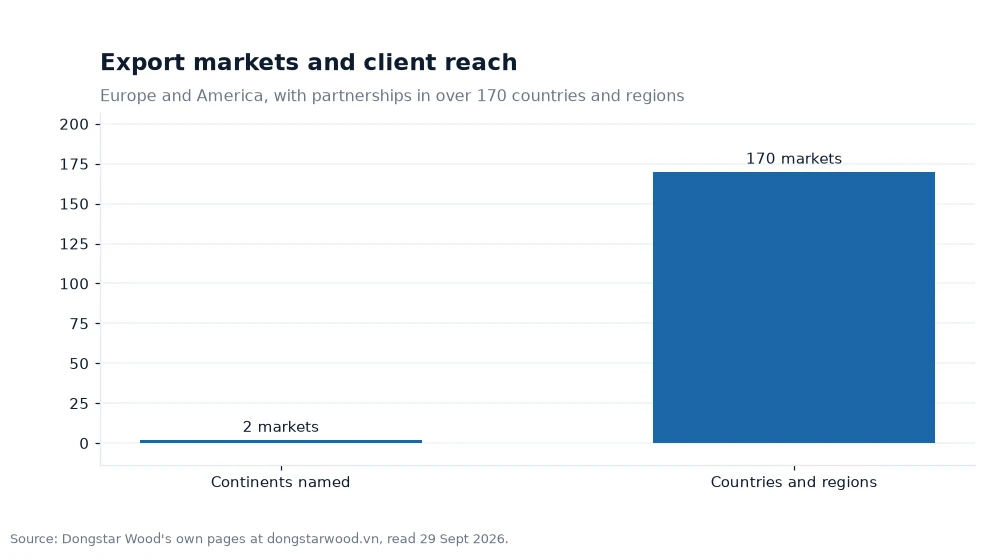
That scale also explains the export reach: partnerships in more than 170 countries and regions, with Europe and America named as the primary markets. Six schemes and 170 markets are not coincidental — a mill that ships broadly meets document requests from many directions, and the certification set is what keeps those shipments moving.
Frequently asked questions
Does a certification list replace an audit?
No, but it reduces what an audit has to prove. Certificates establish that a scheme is held and what its scope covers, while an audit checks whether the plant behaves that way on a normal working day. Both are cheaper and faster when the documents are already filed against a batch reference.
Which document do European buyers ask for first?
Usually the one linked to their own compliance obligation, which today means an EUDR due-diligence statement. FSC and CE documentation normally follow in the same request, and emission grades such as E1 or CARB P2 appear when panels are destined for furniture or enclosed interiors.
Can export paperwork be assembled after the panels are pressed?
Most of it can, since certificates and declarations describe a site and a product family rather than a single sheet. The exception is the EUDR statement, which must be traceable to the supply area behind a specific consignment, so it is far easier to prepare while the batch is still in production.
Requesting the pack alongside the quotation
Put the document request in the same email as the specification, and list what you want by name: FSC certificate with scope, CE declaration for the panel family, EUDR statement for the consignment, and the emission papers for the glue system. Buyers assembling a mixed programme can see what the certification covers in practice by looking through the commercial plywood range and the company's main product pages, where the same schemes are applied across both categories.
Scheme names, site details and market coverage in this piece were taken from that the manufacturer's own website, viewed on 29 Sept 2026 for the numbers in these notes for the numbers in these notes as referenced in this guide[1].